Sunday, June 30, 2019

Saturday, June 29, 2019
Wesch vs Turkle
Wesch vs Turkle
The first reading I began with for this assignment was
with Wesch. I was reading through and I
realized I wasn’t grasping what he was trying to say. I mean, I was getting snip-its here and
there, but I felt a little lost. I
decided to then turn my attention to the Turkle article. This one totally held on tight to how I have
been feeling lately with some people close to me. I agree with her thoughts on
how although we may be right next to someone there may be something lost in our
interaction because we are not fully in the moment. We are not intentionally
listening and responding. Instead we are
absentmindedly nodding our heads to a question we don’t even “know” was asked,
while observing others lifting up their devices every time it alerts the user
they have a message. Funny, I don’t get
that quick of a response when I start an interaction with some. Many are overcome
by power from a small electronic device.
This leads us to Wesch’s article and my thoughts on
technology. If this device is so
powerful, how can we, the teachers and leaders, weave it into students’
learning without it becoming a distraction?
How can we make such a drab classroom become more than what meets the
eye? Let’s face it, many students walk into classrooms, look around and are
instantly turned off at what may take place. They have a hard time envisioning
that crazy inviting lessons could possibly come out of them in such a sterile
environment. It is our job to create a setting where they too believe anything
is possible. We can do this! Possibly with carefully created lessons that are
so meticulously thought out, students could not only learn from technology, but
also reveal their talents that would not have been otherwise noticed. Finding
the avenue where students will not become “techno-zombies,” but are also able
to navigate through the Internet, apps, and all it has to offer may stimulate a
desire for learning. This article discusses how technology has been successful for high school students who would have otherwise dropped out when used interactively, rahter than one-way. Forbes - Technology In The Classroom: The Question Is Not "If" But "How"
.
I believe there can be a happy medium. With planning,
implementing, re-planning and re-implementing our students can thrive with what
they most enjoy while demonstrating their knowledge. This does not go without saying that we need to be vigilant on how often students are allowed turn to their devices. With that thought, this article discusses self-control or lack there of from two smartphone users. Smartphones in the classroom, pro and con.
Thursday, June 27, 2019
"Do You! No Rules Book! creative book

Here is the start of a No Rules Book! creative book, "Do You!
It will be accompanied with several different craft items to make each page your own.
Wednesday, June 26, 2019
Race: Some Teachable and Uncomfortable Moments
 The chapter I
decided to read about and share with our group is a topic I had to get up close
and personal with was during this past Summer I session class. "Race: Some Teachable and Uncomfortable Moments" discusses the topic of racial justice. The literature states that with topics
that need to be covered in the classroom, there are opportunities to open the
door for discussion of such “elephant-in-the-room” topics. Topics being
discussed that bring awareness to injustice that otherwise would not be even touched
upon. Having the opportunity to use the
classroom as a safe environment to help elicit conversation about race and its
influences from the past, the effects on the present, and the future offer a
leeway to meaningful conversation.
These conversations should focus on how repeated past patterns continue
to have influence in today’s society. The teachers in this section used The
Secret Life of Bees, to show the contrast between whites and blacks in the
19602 and Spike Lee’s documentary, 4 Little Girls to show the gap between the
two communities as a starting point. The fact of the matter is that as Heidi
Tolentino stated, “Talking about issues of race is so difficult. It’s painful. Most adults don’t want to touch
it and will silence others when they do.”
She also believes that giving students room to discuss their thoughts
and feelings will allow growth and thinking to those who otherwise wouldn’t. Also,
“…it is crucial that we attempt to understand how the conditions in people’s
lives affect them,” (161) Click here for information from Teaching Tolerance (Teaching Tolerance)
The chapter I
decided to read about and share with our group is a topic I had to get up close
and personal with was during this past Summer I session class. "Race: Some Teachable and Uncomfortable Moments" discusses the topic of racial justice. The literature states that with topics
that need to be covered in the classroom, there are opportunities to open the
door for discussion of such “elephant-in-the-room” topics. Topics being
discussed that bring awareness to injustice that otherwise would not be even touched
upon. Having the opportunity to use the
classroom as a safe environment to help elicit conversation about race and its
influences from the past, the effects on the present, and the future offer a
leeway to meaningful conversation.
These conversations should focus on how repeated past patterns continue
to have influence in today’s society. The teachers in this section used The
Secret Life of Bees, to show the contrast between whites and blacks in the
19602 and Spike Lee’s documentary, 4 Little Girls to show the gap between the
two communities as a starting point. The fact of the matter is that as Heidi
Tolentino stated, “Talking about issues of race is so difficult. It’s painful. Most adults don’t want to touch
it and will silence others when they do.”
She also believes that giving students room to discuss their thoughts
and feelings will allow growth and thinking to those who otherwise wouldn’t. Also,
“…it is crucial that we attempt to understand how the conditions in people’s
lives affect them,” (161) Click here for information from Teaching Tolerance (Teaching Tolerance)
The takeaways from opening the doors and the willingness to use resources that may prompt student responses at a deeper level are opportunities to create discussions. As uncomfortable as they may become they induce a deeper level of thinking and reflection. Here is a graphic organizers to help reveal what may be the cause of our own vulnerability. (Graphic Organizer) and this organizer to assist with how to think ahead and respond in uncomfortable situations (Preparing to Respond in Uncomfortable Situations). Lastly, a list of resources to explore (Resources and Resources)
Tuesday, June 25, 2019
It's a Small World After All
Oh gosh, growing up in an upper
middle class family (B.D. – Before Divorce) our family unit were Disney visiters. I believe we visited Disney more
than a handful of times by the time I was 13.
For me it was a time to escape into a make-believe world where time was
irrelevant and our (my) concerns/ problems didn’t exist. It was a place to get lost into, as I see it
now, a more robotic vacation. All the
vacationers did the same thing. Get on
the Disney Monorail, get off to be taken into a fantasy world, get back on the
monorail, get off at a different park.
As a child watching all of the Disney films, I was able to put myself in
the shoes of the beautiful princesses, to pretend to live in a beautiful
castle, to get mesmerized into thinking that I could possibly be taken away
into a far land where everything WILL turn out just fine.
To be honest, I never thought that
Disney movies were more than a problem and a solution. I never read into a deeper meaning. Thinking
more than what was shown on the surface and intended for me to think. As a
society, we know who the “good” person and “bad” character is, but to pick
apart the reasons why is a whole different perspective. Here is a link to messages hidden in Disney movies, (Subliminal Messages).
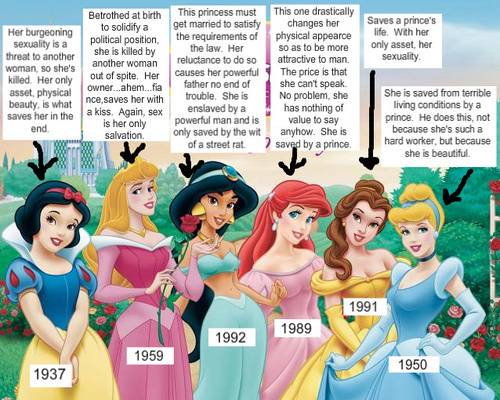 Take a look at this You Tube video that describes the hidden messages. (YouTube)
After reading the section, which
focuses on critiquing fairy tales and cartoons, I had a yuck feeling in my
chest. I honestly never thought of the
cartoons that I watched as a young child portrayed such negativity. I actually never thought about anything so
deep while watching cartoons. One particular cartoon that Christensen
brings up is Popeye. I can now replay
the piece she discusses in the book, where Popeye puts a dog collar around
Olive’s neck and leads her out of harms way. How do I think of it now? Definitely not in the same way. This is going to bring about thinking. When I watch a movie, when I watch a carton,
when I read a fairy tale book. New
perspective, new way of seeing hidden messages. Here is a link to another article, but this one is about hidden sexual messages, (Disney Sexual Messages).

Watching the
Disney movie Frozen through a different lens had me scrutinizing so many
elements, in a way I haven’t done before. However, I think movies like Frozen give me an
opportunity to not get deep into thinking, but instead allows me to watch in a “fluff”
type of way. I don't really know how I will be able to watch another movie without such a critical lens.
Subscribe to:
Posts (Atom)